Leadership in Debt and Receivables: Let Evidence Shape What You Build
By Jeffery Hartman — entrepreneur, builder, and deal maker in receivables (known as “The Don of Debt”) | Category: Business Models & Leadership | Published: 2026-10-03 12:00:00
Leadership in Debt and Receivables: Let Evidence Shape What You Build
In debt and receivables, leadership is not measured by how quickly a team adopts a new tool or how many projects it launches. It is measured by whether the organization can make sound decisions, serve a real customer need, and deliver the result within responsible operating and economic limits.
That requires a different starting point. Before asking what technology to buy, what feature to add, or which process to automate, I want to know what progress the customer is trying to make, what evidence supports that interpretation, and what the organization must be able to do to deliver it. This is how I apply the Christensen Institute’s Jobs to Be Done Theory and business-model thinking to leadership (reviewed October 8, 2026). These are useful lenses—not a formula that removes judgment.
Key takeaways - Define the customer outcome before selecting a tool or reorganizing a workflow. - Treat customer stories, operating data, and experiments as complementary forms of evidence. - Use the value proposition, resources, processes, and economics to test whether an idea can work in practice. - Measure outcomes and guardrails, not activity alone; scale only when value is repeatable and responsible.
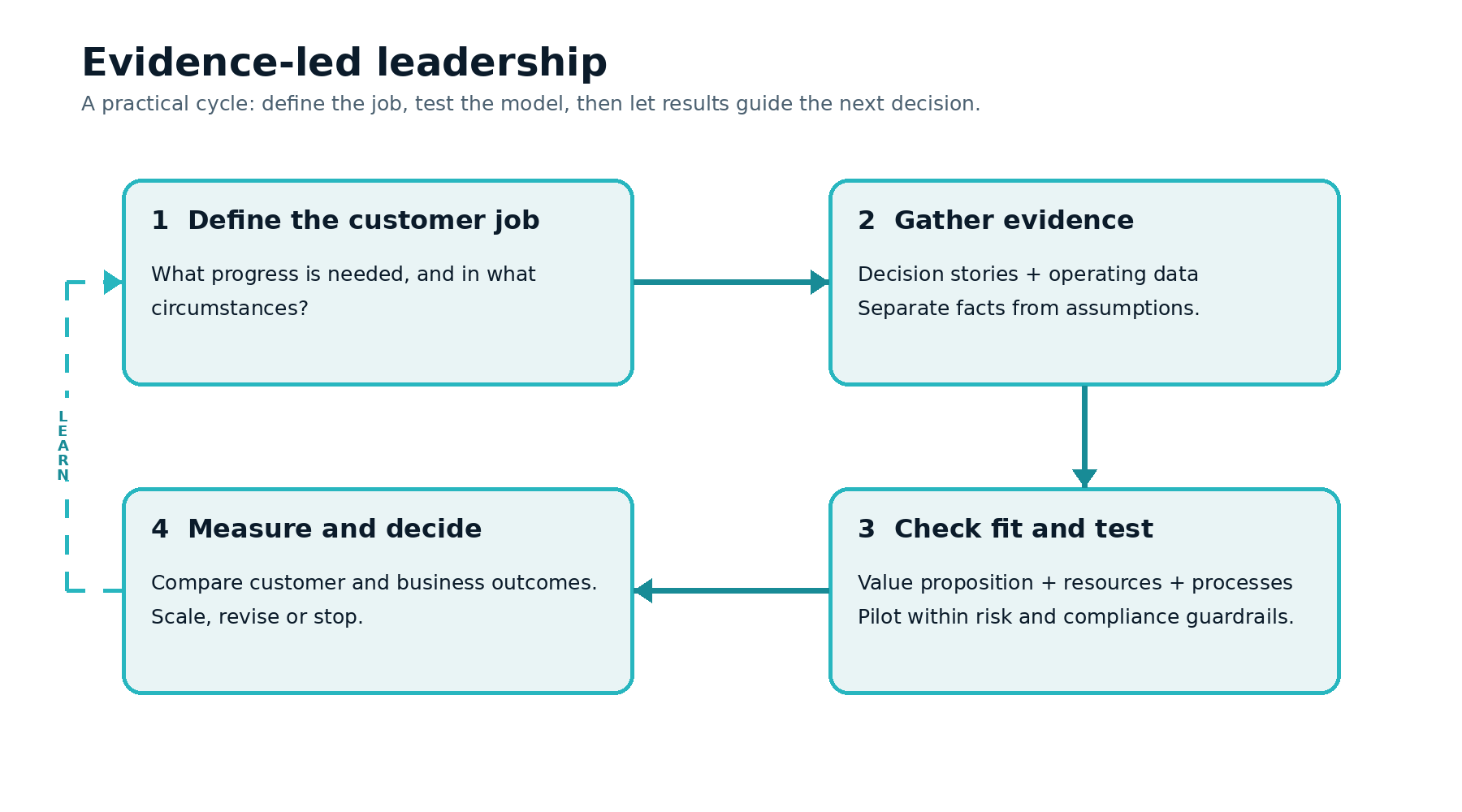
Original diagram: an evidence-to-decision loop created for this article; it is not an official Christensen Institute graphic.
Begin with the customer’s progress
The first leadership decision is to define whose job the organization is trying to help with. “Improve collections” or “use AI” is not a customer outcome. A lender might be trying to make a defensible choice about a portfolio. A buyer may need to judge whether the available data supports a bid. A receivables team may need to resolve disputes and collect the right accounts without creating avoidable friction. These jobs touch the same industry, but they are not interchangeable.
The Jobs to Be Done lens pushes leaders to examine circumstances: what changed, what alternatives existed, what held action back, and what happened after a choice was made. It also reminds us that a decision is rarely only functional. A buyer may need the analysis, but also confidence that assumptions are visible. An operator may need a faster workflow, but also a process that is explainable and controllable. A finance leader may need improved cash timing while protecting the organization’s reputation and obligations.
The leadership discipline is to state the job narrowly enough that people can test it. For example: “Help the credit committee compare two disposition paths using a consistent view of the underlying account data.” That is more testable than “modernize portfolio management.” It also leaves room to discover that the actual obstacle is data readiness, decision rights, or an existing handoff—not a missing dashboard.
Let evidence challenge the plan
A strategy is a set of choices under uncertainty. Evidence helps distinguish the customer’s real difficulty from the explanation the organization has grown accustomed to repeating. I look for three kinds of evidence, and I do not treat any one of them as sufficient by itself.
Decision stories show the sequence. Ask people who recently adopted, rejected, or stopped using an option to walk through the timeline. What triggered the change? What did they try first? Who participated? What caused the decision to become urgent? What was still worrying them? This is where workarounds, nonconsumption, and unserved jobs often surface.
Operating evidence shows what happens in the system. Depending on the business and the applicable rules, useful evidence might include data completeness, exception rates, time to a decision, handoff failures, dispute-resolution timing, recovery or resolution patterns, and the cost of the work. Definitions matter. A “recovery rate” calculated over one time window cannot be fairly compared with a differently defined rate from another cohort.
Experiments test whether a proposed change causes improvement. A bounded test might alter one communication step, data-validation rule, review sequence, or tool interface for a defined group. Before the test, specify the intended outcome, the comparison, the duration, and the guardrails. Do not call a result successful just because the team shipped the change or users clicked the button.
The Jobs to Be Done lens directs leaders to investigate the circumstances that draw people toward or away from a decision and the progress they are trying to make (Christensen Institute, “Jobs to Be Done Theory”, reviewed October 8, 2026). That does not mean discarding quantitative analysis. It means asking the qualitative question that gives the numbers meaning, then measuring whether the answer holds.
Read industry signals carefully
External data can help a leader choose which questions to investigate. It should not be mistaken for a diagnosis of a particular business. The CFPB’s 2025 Consumer Response Annual Report reports approximately 387,400 debt collection complaints received from January 1 through December 31, 2025 (published March 31, 2026; data current March 2, 2026; reviewed October 8, 2026). Of those complaints, it sent approximately 304,700 (79%) to companies for review and response, referred 15% to other regulatory agencies, and found 6% not actionable. Companies responded to 97% of the complaints sent to them; in 84% of that sent-to-company subset, consumers reported first attempting to resolve the issue with the company.
These figures are useful as an external signal about questions to investigate, not as an organization-level diagnosis. They should not be presented as legal-violation counts or as a rate for any particular institution or agency. The CFPB defines a consumer complaint as a submission that expresses dissatisfaction with, or suspicion of wrongful conduct by, an identifiable entity related to a consumer’s personal experience with a financial product or service; the report’s data are current as of March 2, 2026, and its complaint counts are rounded (CFPB, “2025 Consumer Response Annual Report”, published March 31, 2026; reviewed October 8, 2026). For its published Consumer Complaint Database, the CFPB additionally says the data are not a statistical sample of consumers’ marketplace experiences and advises readers to consider company size or market share when interpreting volume (CFPB, “Consumer Complaint Database”, last modified September 14, 2026; reviewed October 8, 2026). The annual report says complaints about debts consumers did not recognize increased 240% compared with the monthly average for the prior two years; use that comparison only with the report’s stated category and period (CFPB report, debt-collection section, reviewed October 8, 2026).
The leadership implication is not “copy one metric into every dashboard.” It is to ask whether the organization can identify why a case reached escalation, distinguish a data problem from a process problem, and learn from the response. A raw complaint count without context can mislead. A carefully classified pattern, combined with operational facts, can point to a testable change.
Use the business model as a leadership check
The Christensen Institute’s “Business Model Theory” defines a business model through four interlocking elements: value proposition, resources, processes, and profit formula/priorities (reviewed October 8, 2026). I use those questions as a practical way to test an idea before the organization commits too much time or capital.
- Value proposition: Which customer job is the idea meant to help? What progress should become easier or more reliable?
- Resources: What people, data, technology, capital, and expertise are required? Are they actually available at the quality and scale the promise assumes?
- Processes: What rules, controls, decisions, handoffs, and exception paths must work? Who is responsible when the data disagree or the case falls outside the normal path?
- Profit formula and priorities: Can the organization provide the value sustainably? What are the costs, revenue mechanics, risk limits, incentives, and trade-offs?
These questions prevent a frequent category error: assuming that a promising feature is the same thing as a workable business model. An automation feature may reduce one manual step while increasing exception work elsewhere. A new analytics layer may improve visibility but fail to change the decision rights that determine action. A system may produce a useful estimate while the organization lacks the data governance or review process to rely on it.
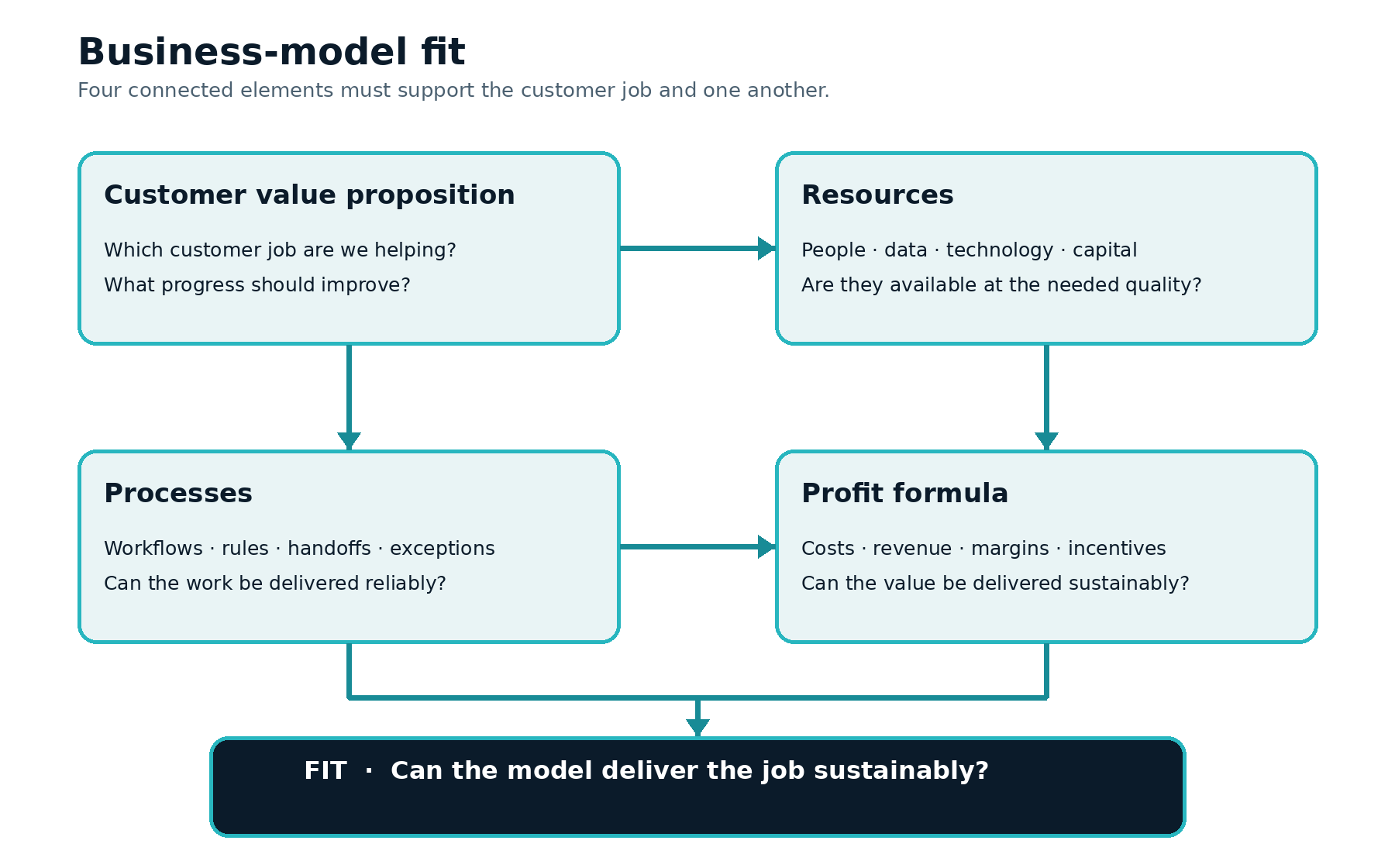
The model is not a checklist to complete once and file away. If the value proposition changes, the required resources and economics may change too. Leadership means noticing that fit—or misfit—early enough to make a different choice.
Measure outcomes, process quality, and guardrails
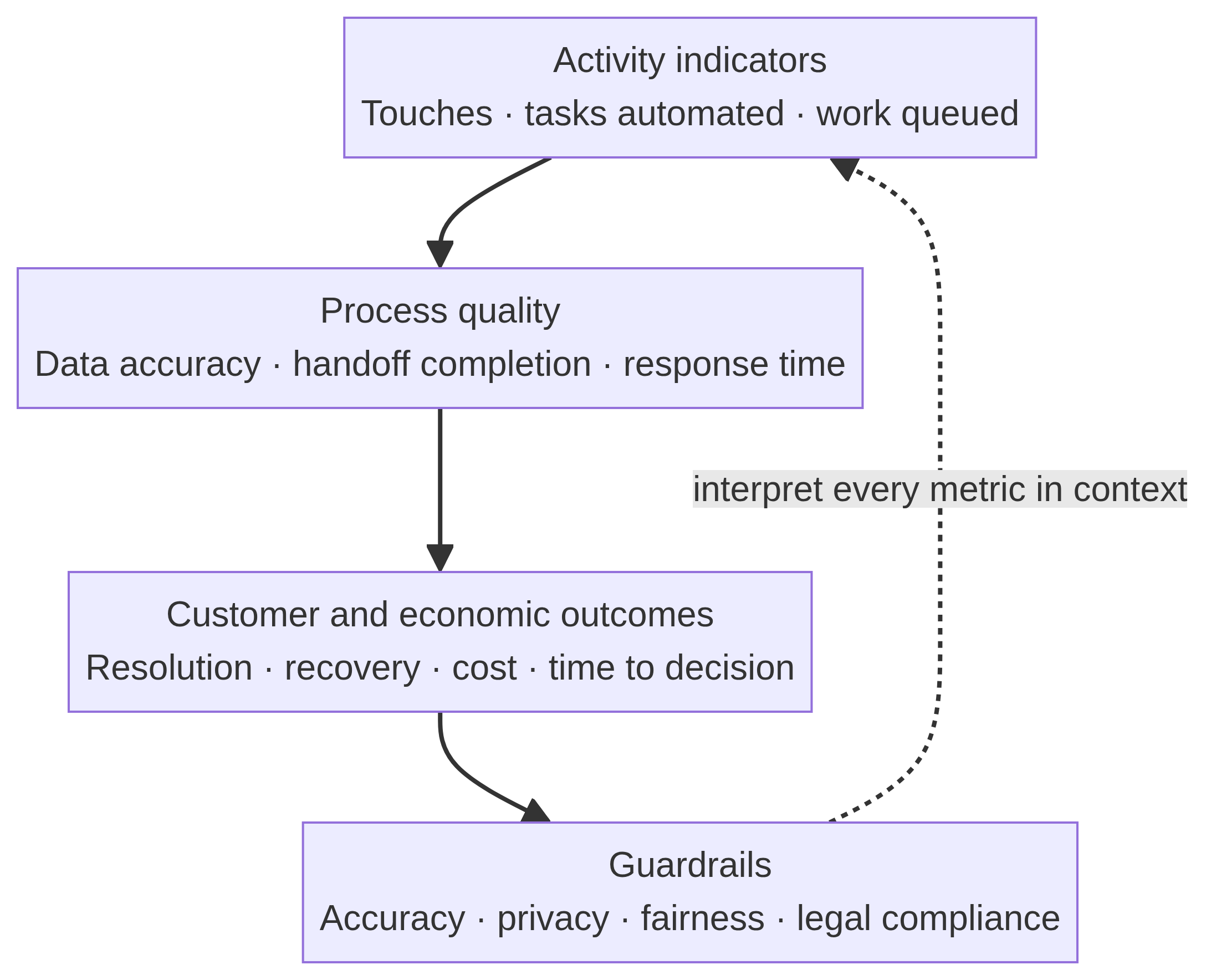
Good measurement distinguishes what the team did from what changed for the customer and the business. Calls placed, records processed, and tasks automated can describe activity. They do not prove progress. Leaders should connect the activity to the process quality and outcome the job requires.
For an initiative in debt or receivables, a scorecard might pair an outcome measure—such as time to a defensible decision, resolution time, or cost per resolved account—with relevant process measures such as data completeness, exception-handling time, and completed handoffs. The appropriate metrics depend on the job, the product, the legal and operational setting, and the quality of the available data. One metric should never silently stand in for another.
Guardrails belong alongside the outcome, not in a review after launch. Accuracy, privacy, fair treatment, documentation, and legal compliance can define the boundaries of a responsible test. If a faster process depends on weaker account verification or hides uncertainty from a decision-maker, it has not created durable value.
Treat technology and AI as means, not strategy
Technology becomes useful when it helps an organization perform a job better within the constraints of its actual business model. That starts with product logic, data relationships, workflow design, and rules for exceptions—not with a claim that a new model or interface will transform everything by itself.
My role is to focus on the market problem, the product logic, the information relationships, and the operating rules, then work with developers and AI tools to turn practical needs into useful systems. That is collaborative product building. It is not a claim that a model can replace people who understand the business, or that I personally write every line of code.
For an AI-enabled workflow, leaders should be able to answer: what input data does it use; what decision or step does it assist; how does it handle missing or conflicting information; when does a person review the result; how are errors noticed and corrected; and what outcome would justify continued use? If the team cannot answer those questions, the organization may not yet have a sufficiently defined job or operating process.
A technology project should also have an explicit stop condition. What evidence would tell the team that the system is not improving the job, that the data are not fit for purpose, or that risk exceeds the value? A strategy that can only be described as “keep investing until it works” is not disciplined experimentation.
A 90-day leadership cycle
The point of a short operating cycle is not to promise a transformation in three months. It is to create a defined opportunity to learn and make a better next decision.
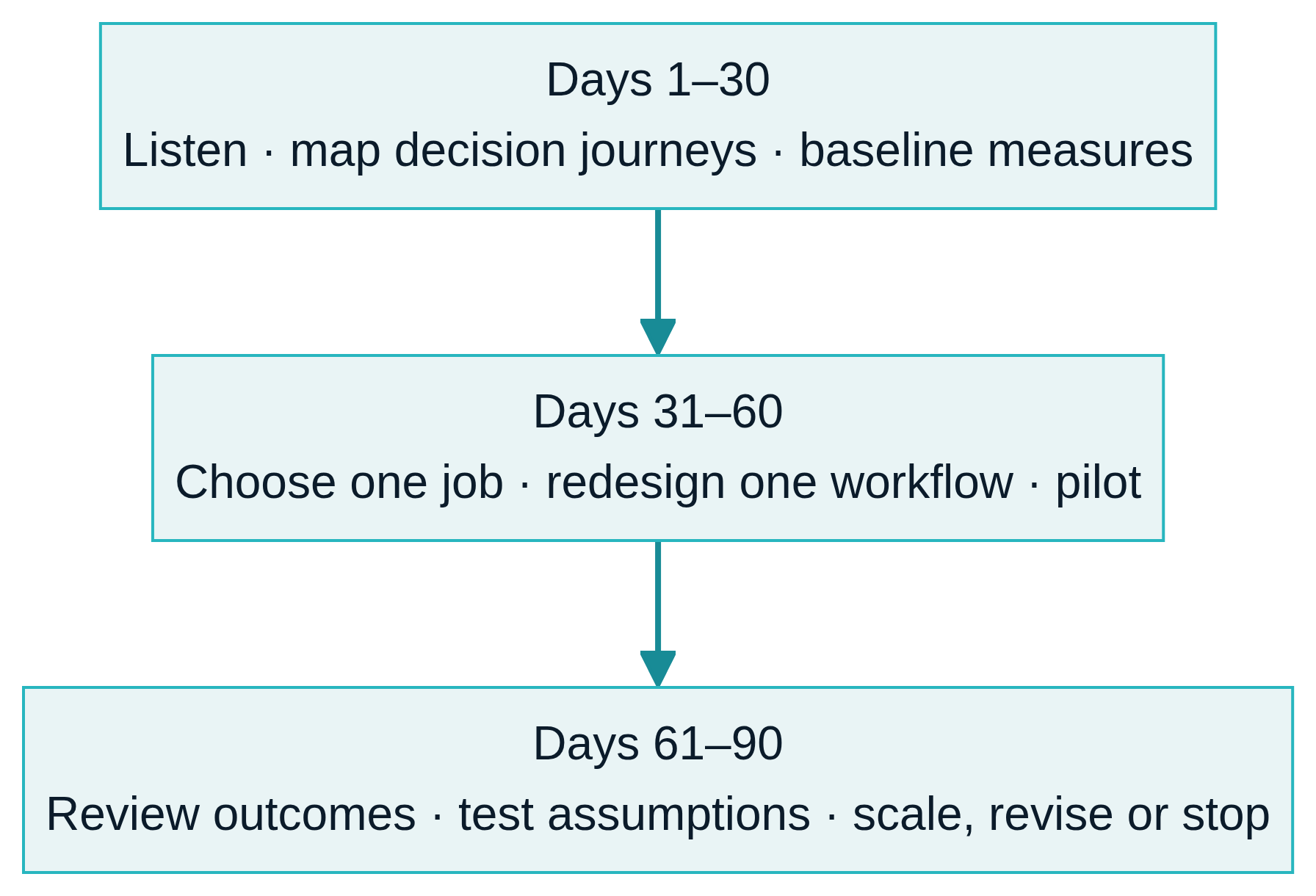
Days 1–30: listen and establish a baseline. Choose one decision or workflow. Map its actual path, interview people close to the decision, document workarounds, and agree on current definitions for the relevant measures. Record what is known, what is assumed, and what evidence is missing.
Days 31–60: choose one job and run a bounded pilot. Pick one change connected to the evidence. Assign an owner, define the comparison, and include risk, privacy, and compliance guardrails. Keep the scope small enough that the team can understand what caused the result.
Days 61–90: decide what the evidence supports. Compare the result with the baseline, listen to users who adopted and those who did not, and check for unintended consequences. Scale only if the value is repeatable and the business model can support it. Otherwise revise the hypothesis or stop the work.
The same discipline can be applied to the Agency Efficiency Audit, the Portfolio Valuation Tool, and the receivables automation buyer’s guide: state the job, make assumptions visible, define what the resource can and cannot tell a visitor, and invite a next step that fits the visitor’s situation.
What evidence-led leadership looks like
Leadership in debt and receivables is not about being certain before anyone else. It is about creating a disciplined way to learn: listen to the decision story, check the operating facts, make the business-model assumptions visible, run a responsible test, and decide what to do next.
That approach also sets a higher standard for the tools and systems we build. The goal is not technology for its own sake. It is a better decision, a more reliable process, or a more useful outcome—delivered in a way the organization can sustain and the people affected can understand.
That is the standard I want my own work to meet: practical problems first, evidence before claims, and systems built around real needs.
For a companion method focused on reconstructing the customer’s decision, read Jobs to Be Done in debt and receivables.
Frequently asked questions
What does evidence-led leadership mean in debt collection?
It means leaders define the customer or operational outcome first, then combine decision stories, operating evidence, and bounded tests to decide what to build or change. It also means measuring relevant guardrails, not only speed or volume.
How can the Christensen business-model framework help a receivables leader?
It gives the leader four connected questions: what value is offered, what resources are required, what processes deliver it, and whether the economics support it. The framework helps expose misfit before a technology or process idea is treated as a complete strategy.
Do CFPB debt-collection complaint numbers prove that a company violated the law?
No. The report describes consumer complaint submissions and how they were routed or handled; it does not characterize its count as a legal-violation finding (CFPB, “2025 Consumer Response Annual Report”, published March 31, 2026; reviewed October 8, 2026). A count alone cannot resolve whether a company violated a law. That consequential determination depends on the particular facts and applicable jurisdiction and should be reviewed by qualified counsel. Leaders should use complaint patterns as a signal to investigate, together with verified case and process evidence.
Sources and framework notes
- Clayton Christensen Institute, Jobs to Be Done Theory.
- Clayton Christensen Institute, Business Model Theory.
- Clayton M. Christensen, Taddy Hall, Karen Dillon, and David S. Duncan, “Know Your Customers’ ‘Jobs to Be Done,’” Harvard Business Review, September 2016.
- Consumer Financial Protection Bureau, Consumer Response Annual Report, calendar year 2025.
The diagrams are original editorial syntheses for this draft, based on the cited frameworks. They are not official Christensen Institute materials.
Related Strategic Briefings
- Jobs to Be Done in Debt and Receivables: Start With the Decision — Apply Jobs to Be Done to debt and receivables decisions, then align offers, data and workflows with customer progress.
- Your Agency’s Operating Model and Data: An Exit-Diligence Protocol — Review how labor-heavy operations, data quality, and process maturity can affect collection-agency valuation and exit readiness.
- If You Can't Connect, You Can't Collect — Learn how call labeling, STIR/SHAKEN, and carrier analytics affect collection calls and agency connectivity.
- Modern Digital Recovery: 6 Practitioner Perspectives — Explore six digital debt recovery strategies, from behavior-based timing and SMS links to self-service and channel orchestration.
Discuss Portfolio Valuation & Liquidity
Looking to structure a portfolio sale or optimize recovery yield? Schedule a strategic call with Jeffery Hartman or test our Portfolio Recovery Valuation Tool.