Jobs to Be Done in Debt and Receivables: Start With the Decision
By Jeffery Hartman — entrepreneur, builder, and deal maker in receivables (known as “The Don of Debt”) | Category: Business Models & Leadership | Published: 2026-10-03 12:00:00
Jobs to Be Done in Debt and Receivables: Start With the Decision
A portfolio does not arrive with a single, obvious instruction. A lender may need to decide whether to work, restructure, or sell it. A buyer may need to decide whether the information supports a bid. An operator may need to decide which accounts, processes, or systems deserve attention first. The useful starting point is not the feature list. It is the decision the person or organization is trying to make—and the progress it needs from that decision.
That is where the Jobs to Be Done (JTBD) lens is useful. Applied carefully, it helps a business understand why a customer acts in a particular situation, what makes action difficult, and what a solution must do to help. It does not replace portfolio analysis, compliance review, or operating data. It gives those tools a clearer question to answer.
Key takeaways - A job is progress sought in a particular circumstance, not a product category or a demographic label. - Lenders, buyers, and operators can face different jobs even when they are looking at the same receivable pool. - A strong offer must fit the customer’s job and the organization’s resources, processes, and economics. - Customer decision stories reveal context; operating data tests whether the proposed solution performs.
Original diagram: a practical synthesis for this article, not an official Christensen Institute graphic.
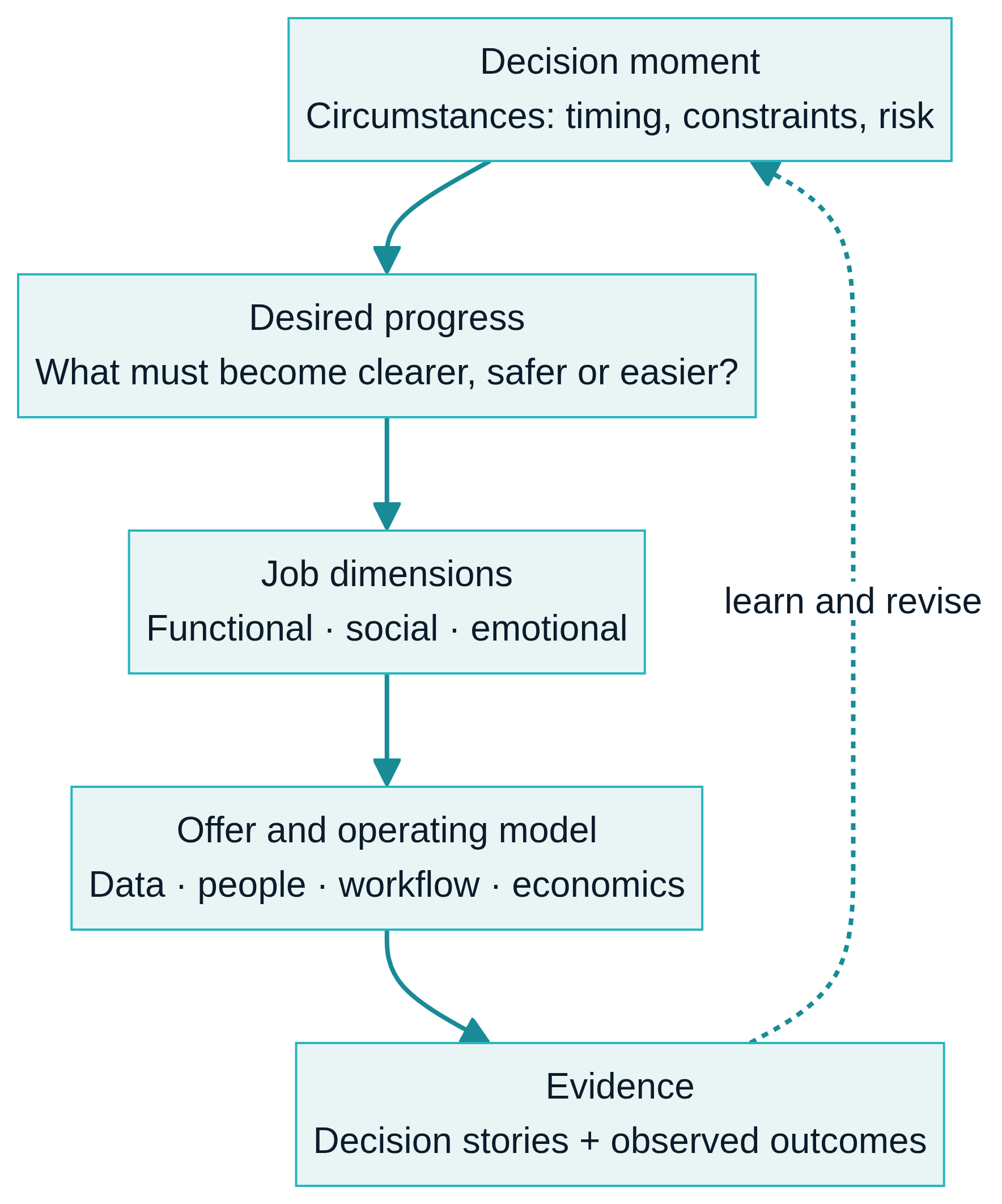
What Jobs to Be Done means in debt and receivables
Jobs to Be Done asks what progress a person or organization is trying to make under specific circumstances. The Christensen Institute defines the theory as a lens for the circumstances—or forces—that move people and organizations toward or away from decisions, including functional, social, and emotional dimensions. Christensen Institute, “Jobs to Be Done Theory” (undated; reviewed October 8, 2026). In B2B, I apply that lens to the people who make or influence the decision; their obligations, incentives, concerns, and limits are context to test, not universal findings.
The word “job” is not a clever way to rename a feature. A buyer does not necessarily “hire” a valuation spreadsheet. The buyer may be trying to decide whether a pool merits further diligence before an investment committee date, while reducing the chance that missing account history changes the economics later. A tool can help with that job, but the job exists before the tool does.
This distinction matters in debt and receivables because the same asset can sit inside several different decision contexts. The seller may be trying to create a defensible disposition path. The buyer may be trying to price uncertainty. The servicing team may be trying to turn accepted accounts into compliant, manageable work. A generic statement like “everyone wants better data” does not explain which decision the data must improve.
The practical question is: what changed, what decision followed, and what would count as meaningful progress? That moves the discussion from broad preferences toward observable circumstances.
Start with the decision, not the persona
Demographics, job titles, and company size can help describe a market. They do not, by themselves, explain why an organization moved now instead of last quarter—or why two apparently similar institutions choose different paths. For that, reconstruct the decision situation.
| Decision-maker | Illustrative job statement | What should be understood |
|---|---|---|
| Lender or originator | “Help me choose a defensible path for this receivable pool while I manage timing, risk, and internal obligations.” | Why is the decision urgent? What must be documented? What alternatives are available? |
| Portfolio buyer | “Help me determine whether this opportunity fits my return, data, and operating requirements before I commit capital.” | Which account-level facts drive the bid? What uncertainty can be priced, mitigated, or rejected? |
| Collections or servicing leader | “Help me direct work to the right accounts and resolve exceptions without losing control of quality or compliance.” | Where do handoffs fail? Which workarounds exist? What does a good resolution look like? |
These are hypotheses, not claims about every lender, buyer, or agency. They should be tested with the people making the decisions. Even within one organization, different stakeholders may “hire” a solution for different reasons: finance may need a credible economic view, operations may need a workable process, and compliance may need traceability and control.
The person who owns the budget may not be the only person whose job determines adoption. If a new process improves an executive’s dashboard but makes frontline exceptions harder to resolve, the offer may be solving one job while making another worse.
Map the customer job to the business model
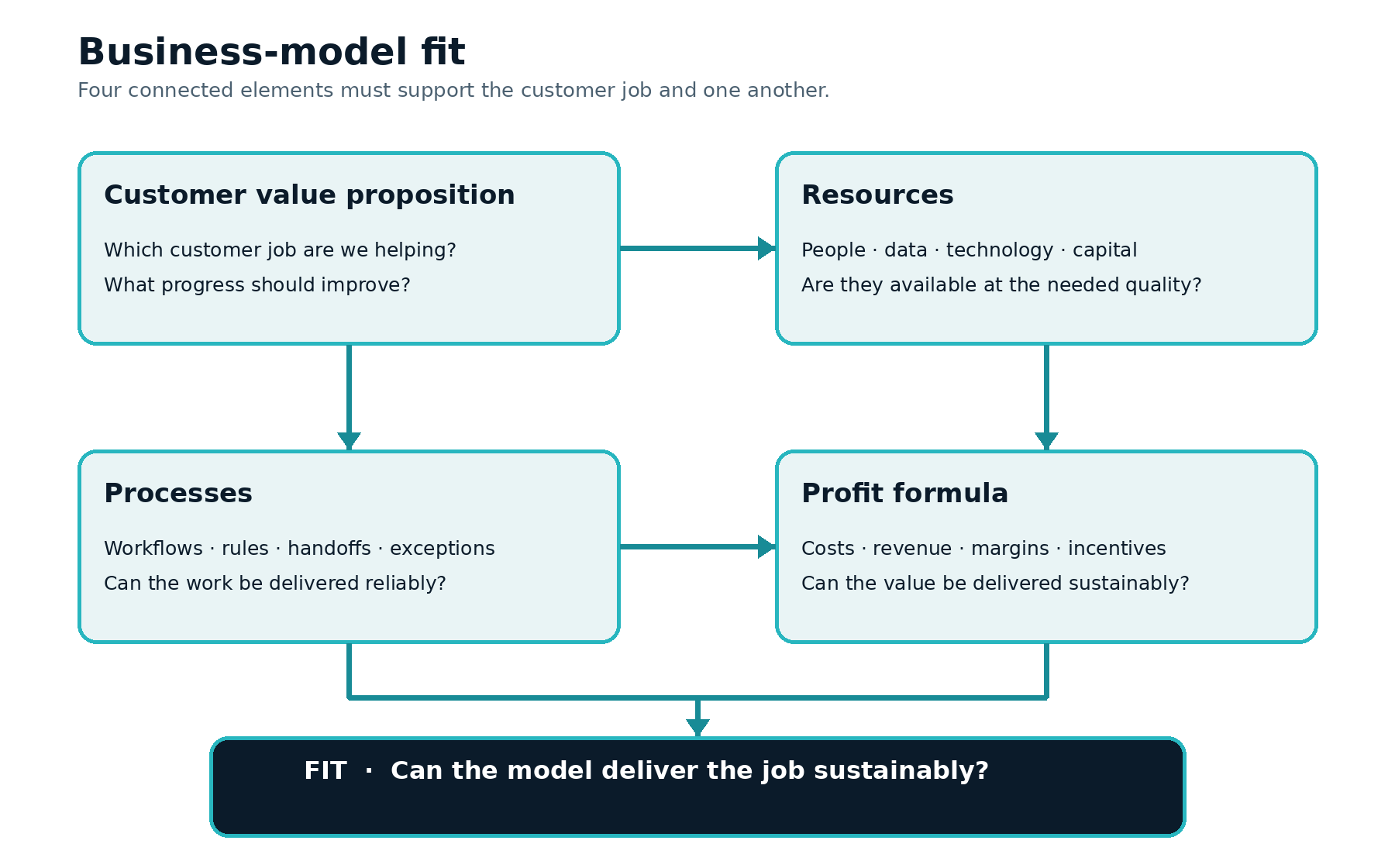
A customer job tells me what progress the offer should enable. In the Christensen Institute’s framework, a business model has four interconnected elements—value proposition, resources, processes, and profit formula/priorities—that together create and deliver value. Christensen Institute, “Business Model Theory” (undated; reviewed October 8, 2026). For a debt or receivables product, I use each element as a practical question, not as a prediction of the outcome of a particular portfolio decision.
| Element | Question to ask | Example in a portfolio decision |
|---|---|---|
| Customer value proposition | Which job are we helping, and what progress matters? | Is the customer trying to compare options, reduce uncertainty, or organize next steps? |
| Resources | What assets and capabilities must we have? | Reliable account data, knowledgeable people, fit-for-purpose technology, and appropriate capital. |
| Processes | How does the work actually get done? | Validation, exception handling, review, approvals, handoffs, and updates. |
| Profit formula and priorities | Can the value be delivered within real economics? | What does the service cost to operate, what can the buyer support, and which incentives shape the work? |
The elements have to fit. A promise of rapid portfolio analysis is not credible if essential data arrive late, key exceptions require manual review, or the economics make proper validation unsustainable. Conversely, a reliable data workflow is not automatically valuable if it does not help the customer reach a decision they need to make.
The diagram below is a simplified teaching aid. It shows one way to test fit; it should not be read as a claim that every organization follows a linear sequence.
Reconstruct the decision timeline
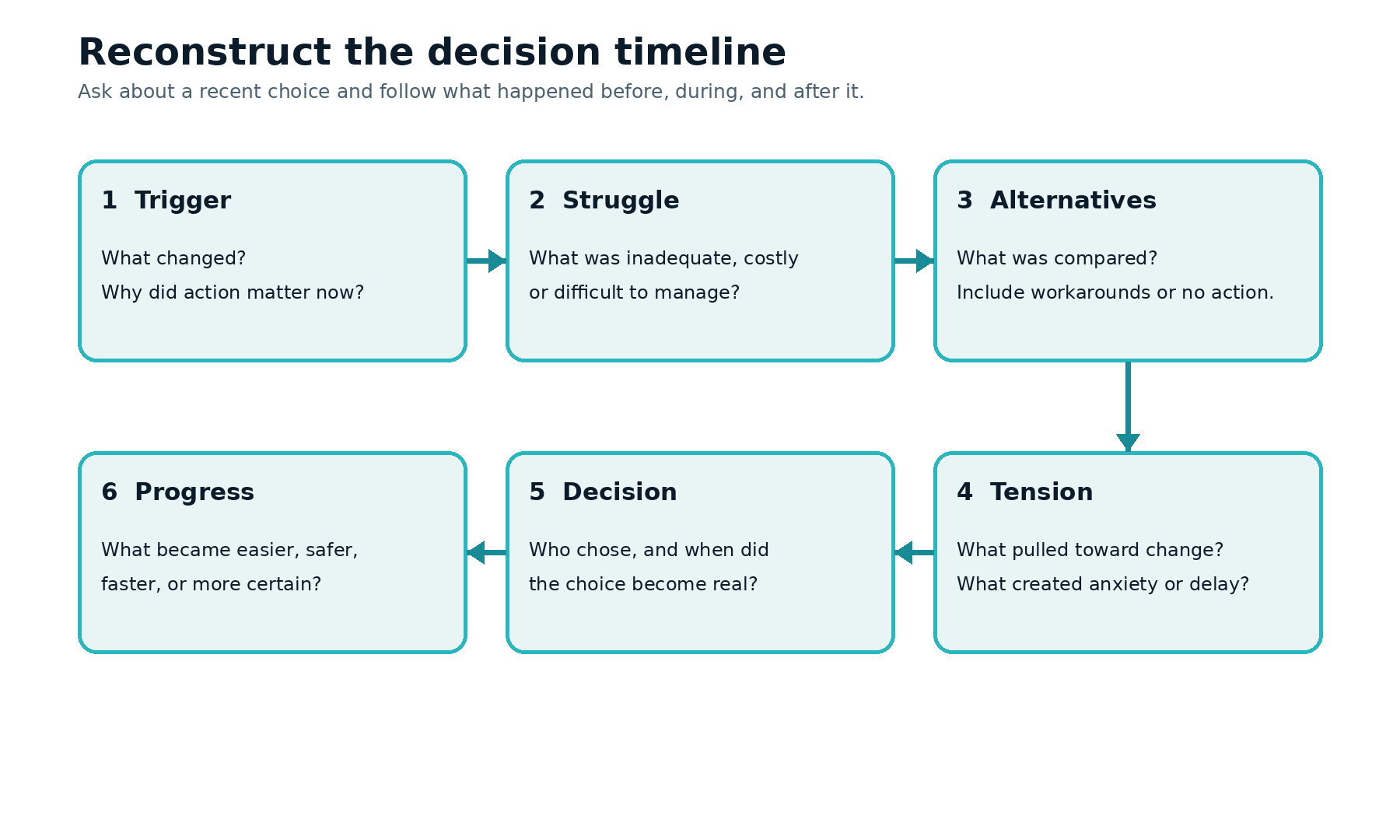
Jobs are easier to understand when the conversation follows the decision as it unfolded. I use the following prompts as an editorial interview aid, not a prescribed or validated research protocol. They are intended to surface decision context, including alternatives and workarounds, rather than to prove why a person chose a product.
A practical interview can follow this sequence:
- Trigger: What changed or happened that put the issue on the agenda?
- Struggle: What made the current approach inadequate, costly, or risky?
- Alternatives: What did the person compare, including doing nothing or using a workaround?
- Tension: What pulled toward a new option, and what anxiety, habit, or constraint held the person back?
- Decision: What was selected, by whom, and at what point did the choice become real?
- Progress: What became easier, safer, faster, or more certain afterward—and what did not improve?
A useful follow-up is to ask what the buyer did immediately before and after the decision. That can surface the practical detail that a broad “why did you choose it?” question misses. For example, in a hypothetical portfolio sale, a seller may say they wanted a strong bid. The timeline may reveal that the immediate job was to make the file reviewable before a committee date, while keeping the decision trail clear enough for internal sign-off.
Use market data as context, not as a substitute for diligence
Public indicators can show the environment in which decisions are made. They cannot price an individual pool. For the quarter ended June 30, 2026, the FDIC reported across all FDIC-insured institutions an annualized 0.57% net-charge-offs-to-loans-and-leases ratio; net charge-offs are charge-offs less recoveries. The rate was down two basis points from the preceding quarter and three basis points from the year-earlier quarter. The Profile also reported loans that were 30 or more days past due or in nonaccrual status at 1.44% of total loans and leases, including 2.81% of credit-card loans. The Profile aggregates the reporting population rather than a geography-specific or receivables-portfolio sample, and says its ratios are weighted aggregates: the sum of individual numerators divided by the sum of individual denominators. FDIC, “Quarterly Banking Profile—Second Quarter 2026” (published August 25, 2026; page updated September 1, 2026; reviewed October 8, 2026).
Those figures help describe system-level conditions. They are not a yield assumption, recovery curve, or benchmark offer for a specific receivables portfolio. Individual outcomes depend on the asset type, account-level information, vintage, legal and contractual status, prior servicing, data completeness, operating capacity, and other portfolio-specific facts. A market statistic can frame a question; it cannot answer the diligence question on its own.
For a specific decision, pair the external context with the evidence the decision actually requires: account-level balances and histories, documentation, aging, payment and recovery patterns, dispute or exception information where available and appropriate, transferability, servicing constraints, and the proposed operating plan. Then make the uncertainty explicit instead of hiding it inside one headline number.
Turn the website into decision support
A website can do more than announce a product. It can help a visitor identify the decision in front of them, understand what the tool can and cannot answer, and choose a sensible next step. That is the structure I want for the resources on my site.
I present the Portfolio Valuation Tool only as a directional planning aid for comparing portfolio assumptions. It is not presented here as an appraisal, a guaranteed offer, or a substitute for portfolio-specific diligence. Whether a particular tool or communication is regulated investment advice, an appraisal, or another regulated activity depends on the governing jurisdiction and facts; I make no legal conclusion, and qualified counsel should review any consequential use or marketing claim. The next question is not merely whether a visitor completes a calculator. It is whether the output helps them clarify the decision and what information they still need.
The Agency Efficiency Audit addresses a different job: examining operating leverage and process choices. The Debt Catalyst valuation briefing is another point of entry for readers interested in data relationships and technology. Each resource should be clear about its intended user, its assumptions, and the boundary of what it can conclude.
A simple site test follows: can a visitor tell, within a short visit, which problem the resource is for, what input it needs, what result it produces, and what the result does not prove? If not, the issue may be positioning or workflow—not a need for another feature.
A 30-day way to test the job
I use the following as a proposed 30-day research cycle—not a validated protocol or a promise of outcomes. It can give a team a structured starting point without requiring a full product rebuild.
| Period | Work | Output |
|---|---|---|
| Days 1–7 | Choose one decision moment; interview recent adopters, people who changed approach, and people who chose not to act. | A short set of decision timelines, including alternatives and obstacles. |
| Days 8–14 | Compare stories for common circumstances; separate observed facts from assumptions. | One or two job statements and a list of evidence gaps. |
| Days 15–21 | Map the proposed offer to the four business-model elements. | A fit check for value, capabilities, processes, and economics. |
| Days 22–30 | Test one small change in language, workflow, data presentation, or process. | A preselected measure and a decision to continue, revise, or stop. |
The goal is not to claim statistical certainty from a handful of interviews. Qualitative work helps explain the decision; operational data and controlled testing help determine whether the proposed change performs. Keep those forms of evidence distinct, then use them together.
The principle: make the decision easier to make well
Jobs to Be Done is valuable in debt and receivables when it keeps the team close to the decision the customer is actually trying to make. The framework does not tell me in advance whether a portfolio should be sold, worked, or held. It sharpens the questions: what changed, what progress matters, what makes action difficult, and what must the business be able to deliver?
From there, the discipline is to align the customer value proposition with the resources, processes, and economics required to support it. Start with the real decision. Test the assumptions. Build only what helps a person or organization make progress—and be direct about the limits of the evidence.
If you are assessing a portfolio decision, start with the Portfolio Valuation Tool as a planning prompt, then validate the assumptions against the underlying data and your own diligence requirements.
For the related leadership application, read my companion briefing on evidence-led leadership in debt and receivables.
Frequently asked questions
What is Jobs to Be Done in debt and receivables?
It is a way to understand the specific progress a lender, buyer, or operator is trying to make in a particular situation. It examines the circumstances and functional, social, and emotional forces around the decision rather than treating a product feature or job title as the whole explanation.
How is Jobs to Be Done different from a customer persona?
A persona describes a type of person or organization. JTBD focuses on a decision and its circumstances. Personas can still be useful, but they do not automatically explain why action happens now, which alternatives were considered, or what progress would make a solution worth adopting.
Can Jobs to Be Done determine a debt portfolio’s value?
No. JTBD helps clarify the decision and the customer’s information needs; it does not itself determine a portfolio’s value. A value conclusion requires portfolio-specific data, defensible assumptions, and appropriate diligence. A directional tool can help organize thinking. Whether a particular output or communication is regulated investment advice or an appraisal depends on jurisdiction and facts, so qualified counsel should review consequential uses.
Sources and framework notes
- Clayton Christensen Institute, Jobs to Be Done Theory.
- Clayton Christensen Institute, Business Model Theory.
- Clayton M. Christensen, Taddy Hall, Karen Dillon, and David S. Duncan, “Know Your Customers’ ‘Jobs to Be Done,’” Harvard Business Review, September 2016.
- FDIC, Quarterly Banking Profile, Second Quarter 2026.
The diagrams are original editorial syntheses for this draft, based on the cited frameworks. They are not official Christensen Institute materials.
Related Strategic Briefings
- Leadership in Debt and Receivables: Let Evidence Shape What You Build — Lead debt and receivables work with evidence: define customer outcomes, test assumptions, and build systems around proven needs.
- The Liquidity Trap: Why Holding NPLs is Toxic in 2026 — Explore how holding non-performing loans affects capital, liquidity, and opportunity costs—and when a sale merits review.
- Your Agency’s Operating Model and Data: An Exit-Diligence Protocol — Review how labor-heavy operations, data quality, and process maturity can affect collection-agency valuation and exit readiness.
- Strategic NPL Portfolio Liquidation: Debt Sales Framework — Use this guide to prepare a distressed loan portfolio sale: organize data, verify ownership, value assets, and approach buyers.
Discuss Portfolio Valuation & Liquidity
Looking to structure a portfolio sale or optimize recovery yield? Schedule a strategic call with Jeffery Hartman or test our Portfolio Recovery Valuation Tool.